The Science Behind Blood-Based Cancer Detection
Justin M. Drake, Ph.D.
Chief Science Officer
How Liquid Biopsy Is Expanding Precision Breast Cancer Care
Key Takeaways
- Liquid biopsy has become an established tool across oncology, supporting genomic profiling, early cancer detection, targeted therapy selection, minimal residual disease (MRD) assessment, and disease monitoring.
- Multiple biomarker platforms including circulating tumor DNA or RNA (ctDNA, ctRNA), cell-free DNA or RNA (cfDNA, cfRNA), proteomics, and multiomic approaches provide complementary biological insights.
- Mammography remains the foundation of breast cancer screening, with MRI and ultrasound serving important supplemental roles for selected patients.
- Emerging blood-based diagnostics are designed to complement not replace breast imaging, particularly for women with dense breasts or complex screening pathways.
- Physicians should evaluate new diagnostics based on clinical validation, analytical performance, laboratory quality, and intended clinical use not solely regulatory pathway.
Precision Oncology Is Moving Beyond Imaging
Over the past decade, oncology has undergone a profound transformation. Advances in molecular diagnostics have shifted cancer care from predominantly anatomical-based assessment to biologically informed decision-making.
Liquid biopsies have emerged as one of the defining technologies driving this evolution.
Upon the success of detecting actionable mutations in advanced malignancies, blood-based diagnostics are now being investigated across the continuum of cancer care—from early detection and risk stratification to treatment selection, disease monitoring, and recurrence surveillance.
The innovation is particularly encouraging in breast cancer.
For physicians who care for women with dense breasts or elevated risk, understanding the science behind these technologies is becoming increasingly relevant as precision medicine expands beyond therapeutic decision-making into earlier stages of detection.
What Is a Liquid Biopsy?
A liquid biopsy analyzes tumor-associated biomarkers circulating in blood rather than requiring tissue acquisition.
Depending on the assay, these biomarkers may include:
- Cell-free DNA or RNA (cfDNA, cfRNA)
- Circulating tumor DNA or RNA (ctDNA, ctRNA)
- Circulating proteins
- Multiomic molecular signatures
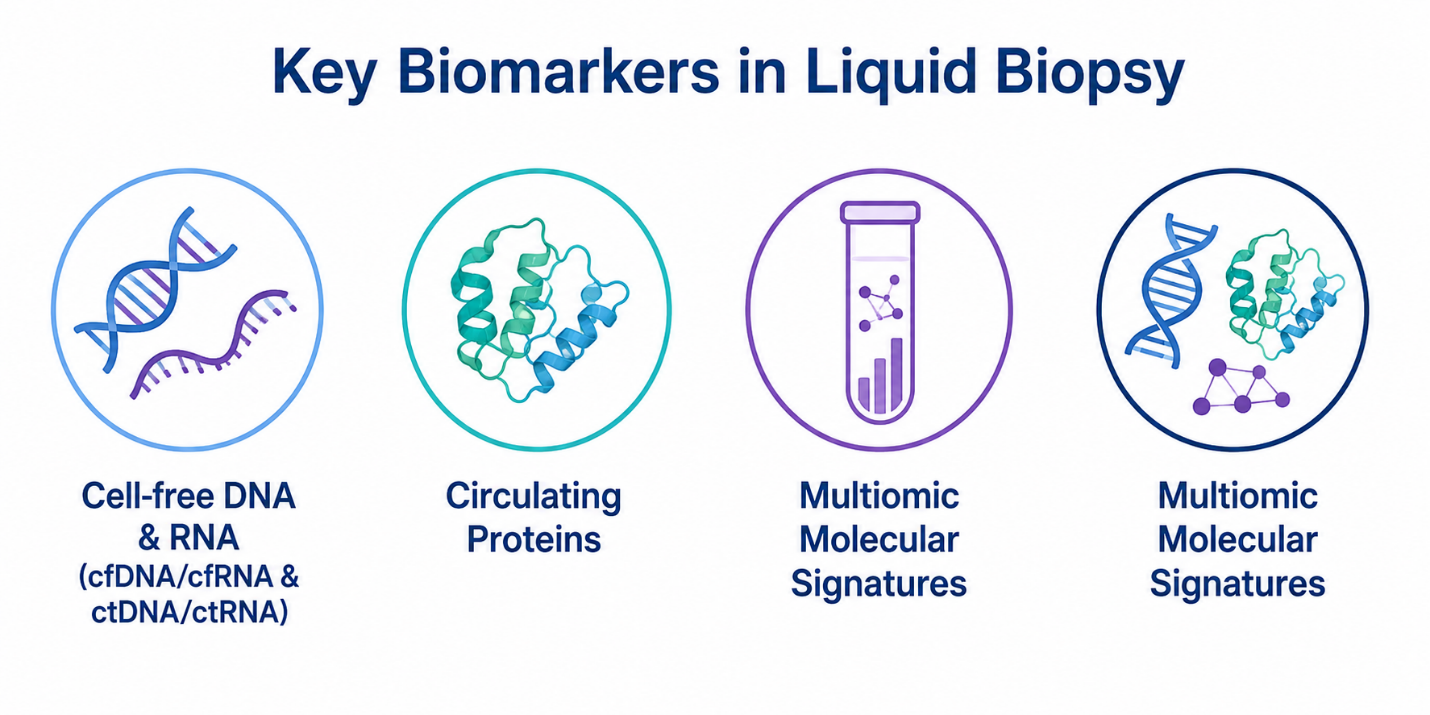
Each provides a different biological perspective on disease.
Rather than replacing imaging or pathology, liquid biopsy offers complementary information that may enhance clinical decision-making throughout the patient journey.
Understanding the Different Biomarker Technologies
| Biomarker | What It Measures | Current Clinical Role | Key Considerations |
|---|---|---|---|
| cfDNA | DNA fragments released by all cells | Background biological material used in molecular assays | Present in all individuals |
| ctDNA | Tumor-derived DNA fragments | Companion diagnostics, mutation profiling, MRD assessment, recurrence monitoring | Highly specific but may be difficult to detect in early-stage cancers due to low tumor DNA shedding; sometimes need paired tissue sample to determine which mutations to look for (tumor-informed) |
| Proteomics | Protein expression associated with biological processes | Emerging applications in early cancer detection and disease characterization | Proteins may reflect biological changes that occur before structural abnormalities become apparent on imaging |
| Multiomic Approaches | Integrated analysis of DNA, RNA, proteins, and computational algorithms | Next-generation early detection research | Designed to improve sensitivity and specificity by combining complementary biomarkers but is likely more costly |
Why Early Detection Requires Different Biology
Many liquid biopsy technologies used in metastatic disease rely on detecting circulating tumor DNA.
Early-stage breast cancer presents a different challenge.
Small tumors often shed very little DNA into circulation, making ctDNA detection technically demanding. In breast cancer, ctDNA shedding is also significantly reduced when compared to other tumor types such as colon or lung cancer. This has prompted investigators to explore additional biomarker classes, including proteins, inflammatory mediators, and multiomic signatures that may provide earlier biological signals.
This is one reason many emerging early detection platforms are increasingly incorporating proteomic analysis alongside genomic technologies.
Rather than asking a single biomarker to answer every clinical question, modern diagnostics recognize that cancer is biologically complex.
Where Blood-Based Testing Fits Within Breast Cancer Screening
Current screening recommendations remain unchanged.
Major organizations including the U.S. Preventive Services Task Force, American College of Radiology (ACR), American Cancer Society (ACS), and American College of Obstetricians and Gynecologists (ACOG) continue to recommend mammography as the foundation of breast cancer screening, with supplemental MRI for appropriately selected high-risk women.
For patients with dense breasts, however, clinicians frequently encounter situations where imaging alone may not fully resolve clinical uncertainty.
Examples include:
- Negative mammography despite persistent concern
- Indeterminate imaging findings
- BI-RADS 3 surveillance decisions
- Supplemental screening discussions
- High-risk patients rotating between imaging modalities
These are the clinical scenarios in which blood-based diagnostics are being explored as complementary tools — not replacements for established imaging pathways.
The Science Behind Certitude
The Certitude™ test was developed specifically to support breast cancer detection in women aged 40 or older with dense breasts (BI-RADS C or D) and a negative mammogram, women with inconclusive or indeterminate mammographic findings (e.g., BI-RADS 0 or 3), high-risk women with a negative or equivocal mammogram, used as part of a high-risk screening rotation, or women with suspicious or positive findings (BI-RADS 3 or 4).
Unlike assays focused exclusively on circulating tumor DNA, Certitude utilizes proteomic biomarkers associated with breast cancer biology, measured through proprietary analytical methods developed by Astrin Biosciences.

The rationale is straightforward.
Protein expression reflects active biological processes occurring within tissues. Changes in these proteins may provide clinically meaningful information even when structural imaging findings remain inconclusive.
According to Certitude clinical validation data1:
- >90% sensitivity
- Greater than 99% negative predictive value (NPV) in women with dense breasts
- Performed in a CLIA-certified, CAP-accredited laboratory
These characteristics are intended to provide physicians with another evidence-based data point when evaluating patients whose screening pathways may be more complex.
Certitude is designed to support, not replace, mammography.
Integrating Blood-Based Testing into Clinical Practice
For physicians, adopting innovative diagnostics requires more than understanding the underlying science.
Successful implementation depends on three questions:
1. Does the technology address an unmet clinical need?
Dense breast tissue continues to present diagnostic challenges despite advances in imaging.
2. Has the assay been rigorously validated?
Analytical validation, clinical performance, and laboratory quality should all be evaluated before incorporating any new diagnostic.
3. Will the results change clinical conversations and decisions?
The greatest value of any diagnostic lies in its ability to inform meaningful clinical decisions and strengthen shared decision-making between physicians and patients.
The Future Is Multi-Modal
The future of breast cancer detection is unlikely to rely on a single technology, as each contributes unique clinical insight. Instead, physicians will increasingly integrate multiple complementary sources of information, including risk assessment, mammography, MRI, ultrasound and blood-based molecular diagnostics.
Rather than competing with imaging, blood-based diagnostics expand the information available to clinicians, supporting more personalized care for women whose screening decisions are less straightforward.
Looking Ahead
Precision oncology continues to redefine how physicians detect and manage cancer. As blood-based diagnostics mature, their greatest contribution may be their ability to complement established screening pathways with additional biological insight.
For physicians caring for women with dense breasts, emerging proteomic technologies represent an opportunity to personalize screening decisions while maintaining confidence in evidence-based care.
Learn More
Interested in understanding how blood-based diagnostics may complement your breast health program? Connect with our team to review the clinical evidence, explore the science behind Certitude, and learn how it may fit into your practice.
Less uncertainty. More confidence.