
Improve Patient Confidence with a Simple Blood Test
High sensitivity.
Reduces anxiety for you and your patients.

>99% NPV
Rules out the need for unnecessary follow-up with high confidence

 Women ≥40 with dense breasts (BI-RADS C or D) and a negative mammogram
- Patients with inconclusive or indeterminate mammographic findings (e.g., BI-RADS 0 or 3)
- High-risk patients with negative or equivocal mammogram, used as part of high-risk screening rotation
- Suspicious or positive findings (BI-RADS 3 or 4)
Certitude is intended for women following screening mammography who require additional risk stratification before further imaging.
It is most appropriate for:
The test has not been evaluated in individuals with a personal history of cancer, other active cancers, autoimmune disorders, or during pregnancy.
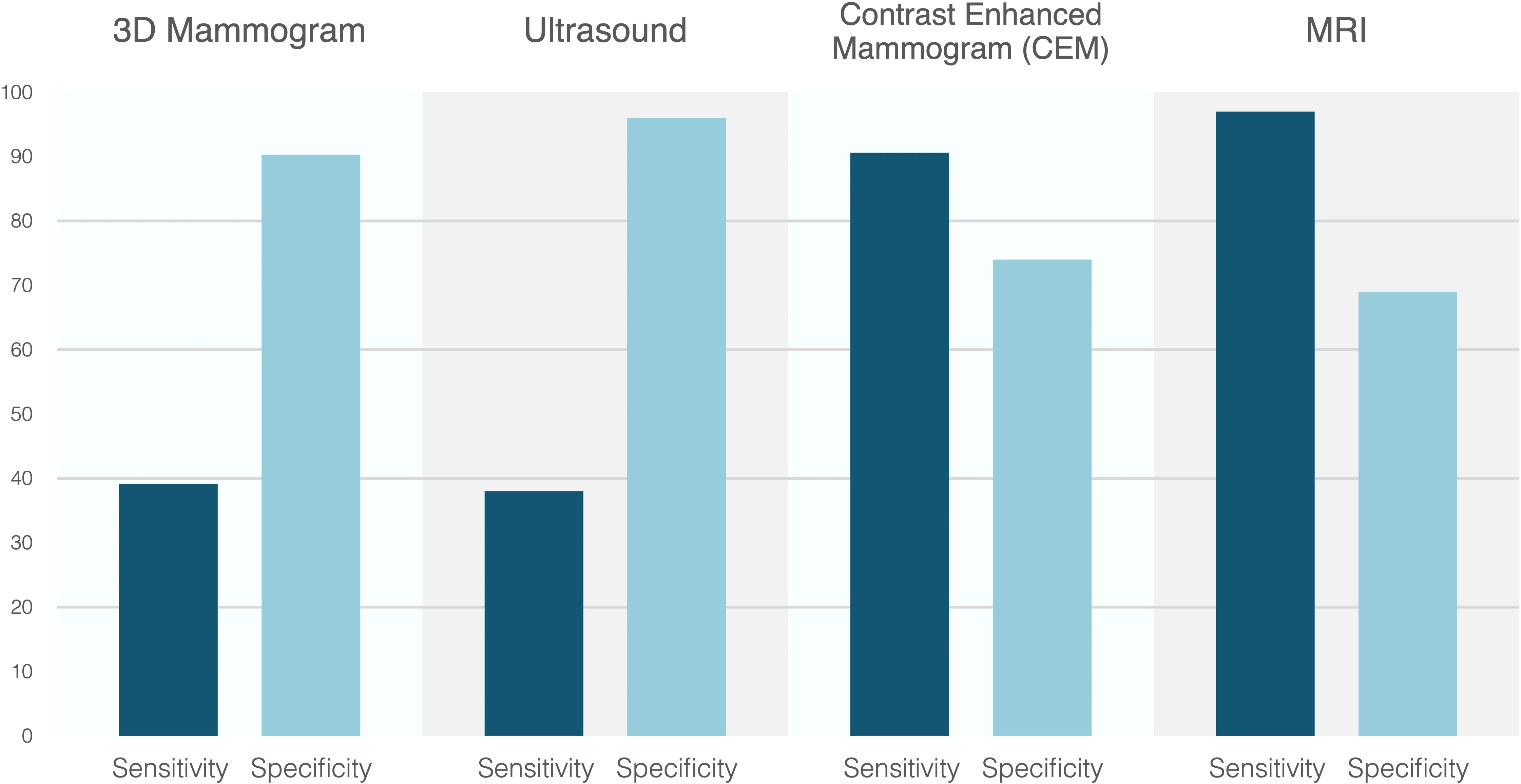
How does current imaging perform?
Compare published sensitivity and specificity across 3D mammography, ultrasound, CEM, and MRI for women with dense breasts. These data do not come from a head-to-head study but provide a comparative side-to-side view.
Certitude Performance
Certitude's clinical utility is in reducing the number of patients who need additional imaging while maintaining high sensitivity for women with dense breast tissue.
92%
Sensitivity
Sensitive and Specific Early-Stage Breast Cancer Detection using Deep Proteome Profiling from Plasma
Drake (SABCS 2026)
90%
Sensitivity in Dense Breast
A Plasma-based Deep Proteomic Platform for Early-Stage Breast Cancer Detection
Horrmann (Endocrinology 2026)
91%
Sensitivity in High Risk Dense Breast
Deep Plasma Proteomics for Early-Stage Breast Cancer Detection
Advani (AACR 2026)
>93%
NPV
Based on Study Results for Benign Breast Conditions vs Cancer
>99%
Negative Predictive Value (NPV)
Based on Population Level Breast Cancer Prevalence
How does Certitude Work?
The Tech Behind the Test
Sample Processing
Blood Sample
Protein Isolation
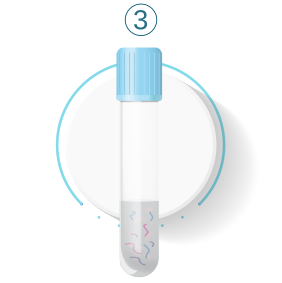
Peptide Generation
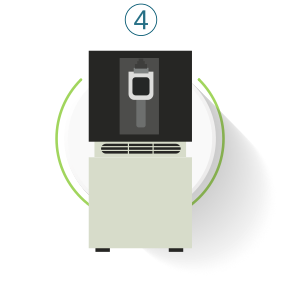
Protein Analysis
Data Analysis
Protein Identification

Machine Learning
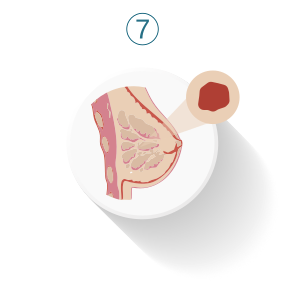
Cancer Proteins Detected
Certitude employs proprietary proteomic analysis to map patterns of circulating protein expression that are distinctly correlated with breast malignancy. These highly specific biomarkers are processed by sophisticated machine-learning algorithms — trained on extensive, clinically validated datasets — to deliver accurate, reproducible results.
Certitude is an Innovative, CLIA-certified, CAP-accredited Blood Test Developed by Astrin Biosciences
It uses advanced proteomic analysis and machine learning to detect protein patterns associated with breast cancer.

Elevate Early Detection
Identify molecular signatures of breast cancer even when imaging is equivocal or inconclusive
Strengthen Clinical Decision-Making
Integrate objective proteomic data with imaging findings and patient risk profiles to guide patients in their screening journey
Maximize Patient Compliance
A familiar, non-invasive blood draw minimizes anxiety and can be conveniently incorporated into any routine office visit
Enable Shared Decision-Making
Provide women with dense breasts a clear path toward more informed and proactive screening next steps
To help contextualize Certitude’s clinical utility, the table below compares its performance with mammography and MRI.
| Detection | |
|---|---|
| Mammography | Limited visibility in dense tissue |
| Certitude Blood Test | High sensitivity with 99% NPV |
| MRI | High sensitivity, frequent false positives |
| Patient Experience | |
|---|---|
| Mammography | Compression, radiation exposure |
| Certitude Blood Test | Simple, standard blood draw |
| MRI | Time-intensive, expensive, limited access |
| Accessibility | |
|---|---|
| Mammography | Widely available |
| Certitude Blood Test | Broadly accessible via standard labs |
| MRI | Specialist centers only |
| Use Case | |
|---|---|
| Mammography | Primary screening |
| Certitude Blood Test | Rule out test before follow-up imaging |
| MRI | Follow-up/High-risk imaging |
Just Blood. No Sweat. No Tears.
Certitude integrates effortlessly into any clinical setting—requiring no new equipment or complex logistical changes.
Workflow Process
Contact Certitude to establish your account. Receive onboarding support and ordering access.
No Abnormal Protein Pattern Detected: Indicates that no additional testing is needed. Continue routine screening.
Abnormal Protein Pattern Detected: Indicates additional testing is needed. It does not necessarily mean cancer. It signals the need for further evaluation. Next steps are typically to administer a mammogram, ultrasound, or breast MRI as a confirmatory test as determined by the treating provider's discretion and judgement.


Coverage & Support
- We are actively working on establishing insurance coverage for the Certitude test.
- The Certitude test is available via self-pay. Patients will have to cover the out-of-pocket cost.
- Patients may be able to use pretax dollars in their flexible spending account (FSA) or health savings account (HSA) to pay for the Certitude test.
Straightforward Out-of-Pocket Pricing
Certitude is currently available to reserve at our introductory self-pay rate through our Early Access Program. Transparent pricing allows patients and providers to move forward without delays or uncertainty.
Certitude Test
For a limited time, secure access to the Certitude test at the introductory self-pay rate.
Patients who participate in the Early Access Program will be eligible to complete testing on or before December 31, 2027 at their reserved rate, regardless of future price increases.*
Includes test kit, sample processing, digital results
No hidden fees
*Early Access pricing is available only to patients who reserve their test on or before December 31, 2026. Testing must be completed by the end of 2027. We anticipate the future list price for the Certitude test will be $750 or more after the Early Access period ends. Pricing may vary depending on the practice setting or healthcare provider who orders your test.
How does this compare to other breast cancer screening costs?
| Breast Cancer Screening Test Options | Out-of-Pocket Costs* |
|---|---|
| Certitude blood test | $525 (list price $750) |
| 2-D mammogram | $100$350 |
| 3-D mammogram (DBT) | $100$600 |
| Breast ultrasound | $200$800 |
| Contrast-enhanced mammography (CEM) | $200$1000+ |
| Breast MRI (full) | $700$3000+ |
| Abbreviated (fast) breast MRI | $250$500+ |
*Regional & facility variantion is large