What Every Physician Needs to Know About Dense Breasts
Badrinath Konety, M.D.
Chief Medical Officer
Understanding Breast Density and Its Impact on Screening Decisions
Breast density has become an increasingly important consideration in breast cancer screening. As breast density notification laws and updated FDA requirements have expanded patient awareness, more women are asking, "What does it mean to have dense breasts, and what should I be doing differently?"
For providers caring for women with dense breasts, understanding how density influences both cancer risk and imaging performance is essential. Today's screening landscape offers more options than ever including mammography, breast MRI, ultrasound, and emerging blood-based tests, but each plays a different role within comprehensive breast care.
What Are Dense Breasts?
Breast density describes the proportion of fibroglandular tissue compared with fatty tissue seen on a mammogram. It is categorized using the BI-RADS® breast density classification1:
- A: Almost entirely fatty
- B: Scattered fibroglandular density
- C: Heterogeneously dense
- D: Extremely dense
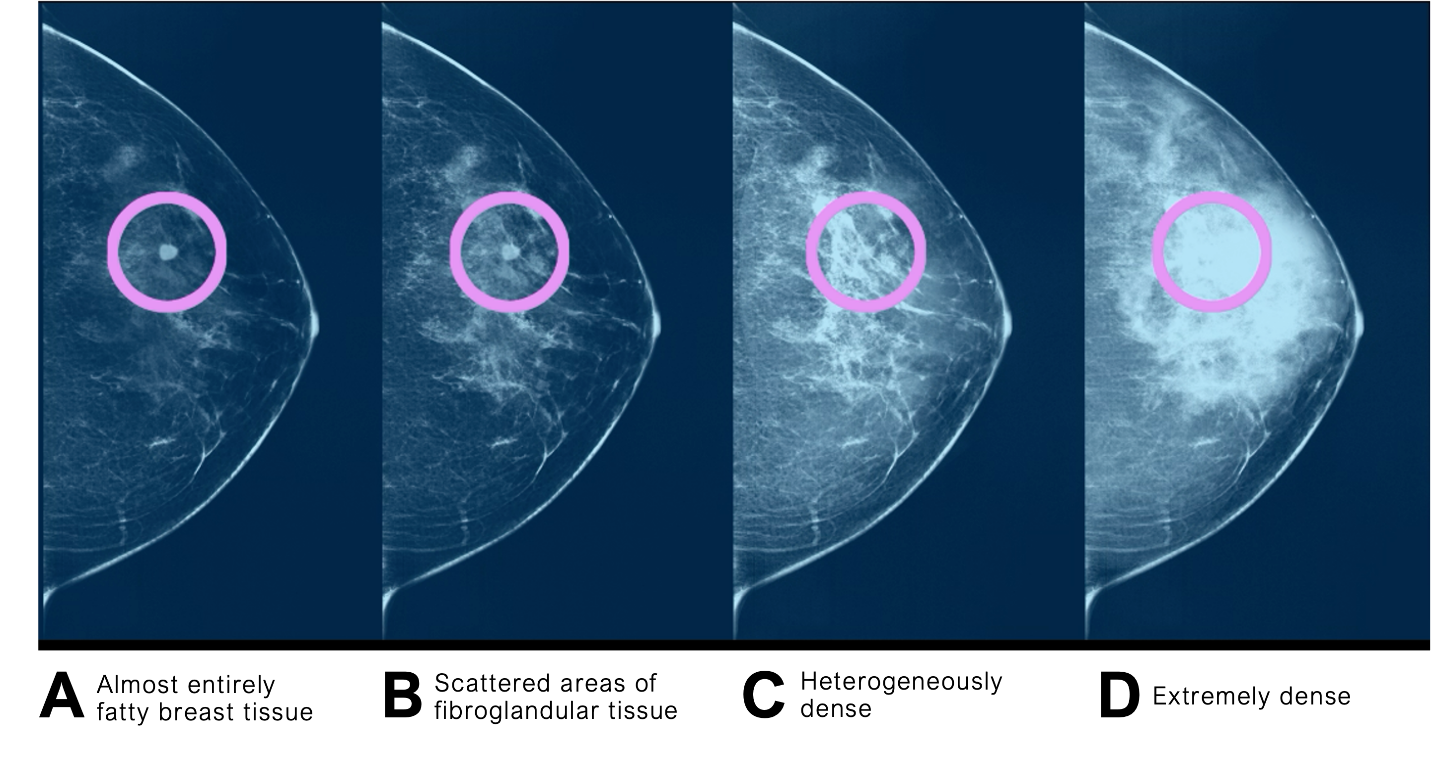
Women classified as BI-RADS C or D are considered to have dense breasts.
Dense breast tissue is common. Approximately 40–50% of women undergoing screening mammography have dense breast tissue, making it one of the most frequently encountered findings in breast imaging.2
Importantly, breast density is not something patients or physicians can feel during a physical exam. It can only be determined through mammographic imaging.
Why Breast Density Matters
Dense breasts matter for two primary reasons.
1. Increased Breast Cancer Risk
Dense breast tissue is an independent risk factor for breast cancer. Women with extremely dense breasts have a significantly higher risk of developing breast cancer than women with predominantly fatty breast tissue.3
Breast density should therefore be considered alongside other established risk factors, including:
- Family history
- Genetic mutations (such as BRCA1/2)
- Prior atypical breast lesions
- Previous chest radiation
- Personal history of breast cancer
- Reproductive history and hormonal exposures
While breast density alone does not necessarily place a patient into a high-risk category, it should be incorporated into individualized risk assessment models whenever appropriate.
2. Reduced Mammographic Sensitivity
Dense fibroglandular tissue appears white on a mammogram — the same color as many breast cancers. This "masking effect" can make small cancers more difficult to detect, reducing the sensitivity of mammography in women with dense breasts.
This is one reason why interval cancers—those diagnosed between routine screening examinations—occur more frequently among women with dense breast tissue.4
How Different Screening Modalities Perform
Mammography
Mammography remains the foundation of breast cancer screening and continues to demonstrate a clear mortality benefit. It should remain the starting point for routine screening.
Strengths
- Widely available
- Proven effectiveness
- Lower cost
- Fast examination compared to other imaging methods
Limitations in Dense Breasts
- Reduced sensitivity
- Potential masking of small lesions
Breast MRI
Breast MRI offers the highest sensitivity among supplemental imaging modalities and is recommended for women at elevated lifetime risk.
MRI may be appropriate for patients with:
- BRCA mutations
- ≥20% lifetime breast cancer risk
- Strong family history
- Certain hereditary syndromes
Strengths
- Increased sensitivity even in women with dense breast
- Detects small lesions
- Possibility of abbreviated imaging
Limitations
- High cost
- Limited availability
- Longer examination times
- Requires contrast administration
- Increased false positive rate
Breast Ultrasound
Whole-breast ultrasound is commonly used as supplemental imaging following mammography, particularly when MRI is unavailable or contraindicated.
Strengths
- No radiation
- Greater accessibility
- Improved visualization in dense tissue
Limitations
- Increased false positive findings
- High operator dependence
- Additional benign biopsies
Emerging Blood-Based Testing
Blood-based diagnostics are an emerging area of breast cancer detection designed to complement and not replace standard imaging.
For women with dense breasts, blood-based testing may provide another layer of information when imaging findings remain uncertain or when physicians seek additional clinical confidence.
Certitude™ is a blood-based laboratory-developed test designed specifically for women with dense breasts. With reported clinical performance of 90% sensitivity and greater than 99% negative predictive value in dense breasts, it is intended to support clinical decision-making alongside established screening pathways.5
Rather than replacing mammography, blood-based testing may help physicians make more informed follow-up decisions while supporting conversations with patients.
Talking to Patients About Dense Breasts
Patients often interpret a dense breast notification as alarming. Clear communication can help reduce unnecessary anxiety while reinforcing the importance of continued screening.
Helpful discussion points include:
- Dense breasts are common.
- Dense breast tissue does not mean cancer is present.
- Mammography remains essential.
- Additional screening may be appropriate based on overall risk—not density alone.
- Screening recommendations should be individualized.
Shared decision-making remains central to selecting supplemental screening strategies.
What Current Guidelines Recommend
Major organizations including the American College of Radiology (ACR), American College of Obstetricians and Gynecologists (ACOG), and American Cancer Society (ACS) agree on several key principles:
- Mammography remains the primary screening test.
- Breast density should be included in individualized risk assessments.
- Women at elevated lifetime risk may benefit from supplemental MRI.
- Decisions regarding supplemental screening should consider breast density, overall risk, patient preferences, and access to care.
There is no one-size-fits-all approach for women with dense breasts.
Bringing Greater Confidence to Dense Breast Care
As breast cancer screening evolves, physicians have more opportunities to personalize care than ever before.
Understanding breast density is the first step. Combining individualized risk assessment with appropriate use of mammography, MRI, ultrasound, and emerging blood-based testing allows clinicians to build screening strategies tailored to each patient.
Certitude is designed to provide another layer of insight for women with dense breasts when standard screening leaves questions—supporting informed clinical decisions while fitting seamlessly into existing workflows.
Interested in learning how Certitude may complement your breast screening pathway? Learn more about integrating Certitude into your practice and discover how a blood-based option can support confident, patient-centered care.