What Physicians Should Know About Laboratory-Developed Tests in Breast Cancer Detection
Justin M. Drake, Ph.D.
Chief Science Officer
Evaluating Quality, Clinical Validation, and the Role of LDTs in Modern Breast Care
For physicians practicing personalized, preventive medicine, innovation is only valuable if it is supported by rigorous science.
As blood-based diagnostics continue to expand across oncology, clinicians are increasingly evaluating laboratory-developed tests (LDTs) as potential additions to patient care. Yet one question continues to arise:
If a test isn't FDA approved, how should physicians evaluate its quality?
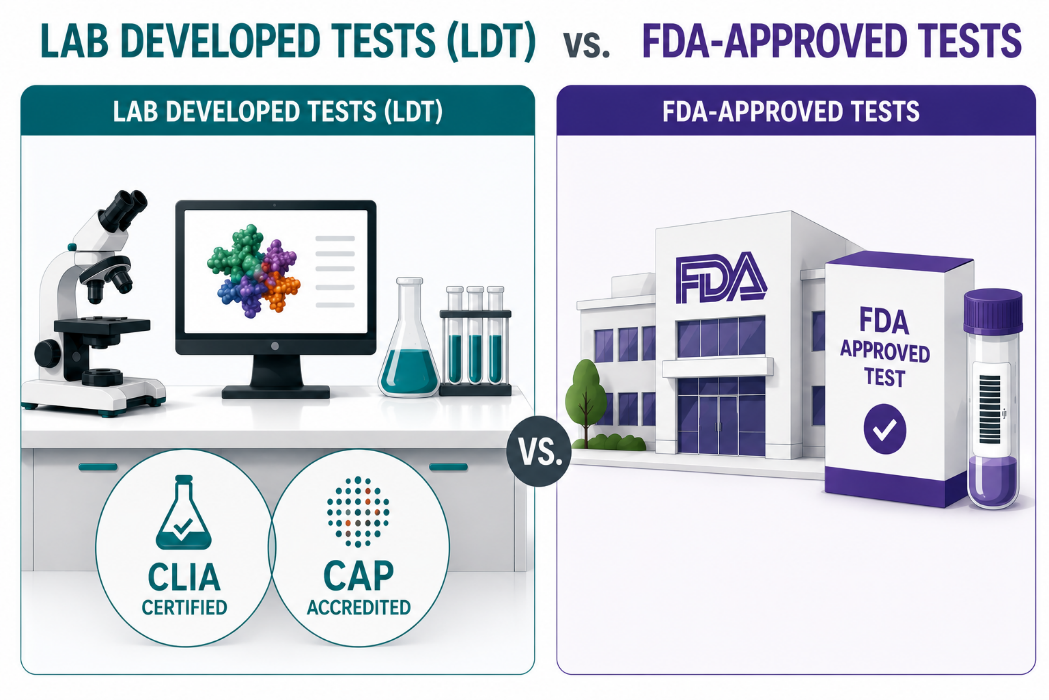
The answer begins by understanding how LDTs are regulated—and the quality systems that support them.
Laboratory-Developed Tests Are Already Part of Modern Medicine
Although the term laboratory-developed test may sound unfamiliar outside laboratory medicine, LDTs have long been incorporated into clinical practice across numerous specialties.
Today, physicians routinely rely on many commonly known LDTs like the following:
- Molecular Oncology: Tempus xT®, Caris MI Profile®, FoundationOne Heme®
- Genetic Testing: Myriad myRisk®, Ambry CancerNext®
- Precision Medicine: OncoType DX® Breast Recurrence Score, Natera Signatera™, Tempus xF®
- Infectious Disease Diagnostics: Karius Test®
- Prenatal Screening: UNITY™, Myriad Prequel®, Natera Panorama NIPT
- Specialized Biomarker Analysis: Mayo Autoimmune Encephalitis Panel
Unlike commercial diagnostic kits distributed to multiple laboratories, an LDT is designed, validated, and performed within a single certified laboratory under established quality standards. This model enables laboratories to develop highly specialized tests that address evolving clinical needs.
Looking Beyond FDA Approval
FDA approval is one pathway for evaluating medical products, but it is not the sole framework governing diagnostic quality.
Clinical laboratories performing LDTs are regulated under the Clinical Laboratory Improvement Amendments (CLIA) and may also pursue accreditation through the College of American Pathologists (CAP) — two quality systems that focus on laboratory operations, analytical performance, and ongoing quality management.
For physicians evaluating a diagnostic test, the most relevant questions often include:
- Has the assay been analytically validated?
- Is the laboratory operating under recognized quality standards?
- Is there evidence supporting the intended clinical use?
- Does the test integrate appropriately into patient management?
These considerations frequently have greater clinical relevance than the presence or absence of FDA clearance alone.
Why CLIA and CAP Matter
CLIA Certification
CLIA establishes national standards for laboratories performing human diagnostic testing.1 Certification requires laboratories to demonstrate consistent quality through:
- Validated testing methodologies
- Qualified laboratory personnel
- Equipment maintenance
- Quality assurance programs
For clinicians, CLIA certification provides confidence that laboratory processes are designed to produce accurate and reproducible results.
CAP Accreditation
Many high-complexity laboratories pursue an additional layer of oversight through CAP accreditation.2 CAP evaluates:
- Laboratory operations
- Test validation
- Quality management systems
- Personnel competency
- Continuous quality improvement
- Ongoing performance monitoring
- Patient safety processes
Because inspections are conducted by practicing laboratory professionals, CAP accreditation is widely regarded as one of the most rigorous quality programs in laboratory medicine.
For physicians introducing new diagnostics into practice, CLIA certification combined with CAP accreditation signals a laboratory's commitment to maintaining high operational standards.
Clinical Validation Matters as Much as Laboratory Quality
Operational quality is essential but it represents only one part of evaluating a diagnostic test.
Physicians should also examine:
- Clinical validation studies
- Performance characteristics
- Intended-use population
- Appropriate clinical context
- How results influence patient management
A test's value ultimately depends on whether it generates clinically meaningful information that supports evidence-based decision-making.
Blood-Based Testing in Breast Cancer Detection
Blood-based diagnostics are emerging as complementary tools within breast cancer detection, particularly for women whose screening pathways are more complex.
Additional information may help guide shared decision-making for patients with:
- Dense breast tissue
- Indeterminate imaging findings
- Elevated breast cancer risk
- Persistent uncertainty following routine screening
Importantly, blood-based tests for early breast cancer detection are not intended to replace mammography. Instead, they are designed to provide another layer of clinical insight when interpreted alongside imaging findings, patient history, and overall risk assessment.
Where Certitude Fits
Certitude™ is a blood-based laboratory-developed test designed to support physicians caring for women with:
- Dense breasts (BI-RADS C or D) and a negative mammogram
- Inconclusive or indeterminate mammographic findings (e.g., BI-RADS 0 or 3)
- High-risk women with negative or equivocal mammogram, used as part of high-risk screening rotation
- Suspicious or positive findings (BI-RADS 3 or 4)
The test is performed in a CLIA-certified, CAP-accredited laboratory, reflecting adherence to established laboratory quality standards. According to Certitude's clinical validation data3, the assay demonstrated:
- >90% sensitivity
- Greater than 99% negative predictive value (NPV) regardless of breast density
For physicians, a highly reassuring negative result may serve as another evidence-based data point when considering follow-up recommendations. As with any diagnostic, results should always be interpreted within the broader clinical context and should complement not replace standard imaging and clinical evaluation.
Innovation Requires Both Science and Trust
Medicine increasingly emphasizes proactive, personalized care. As diagnostic technologies evolve, physicians have an opportunity to expand the information available to patients but only when those innovations are grounded in rigorous science and implemented thoughtfully.
Laboratory-developed tests have become an established component of modern medicine across multiple specialties from primary care to oncology. Evaluating them through the lens of laboratory quality, clinical validation, and appropriate use can help physicians determine how they fit into comprehensive patient care.
For women with dense breasts or more complex screening pathways, blood-based diagnostics such as Certitude may offer another layer of insight that supports confident clinical decision-making while integrating into established breast care workflows.
Learn More
Interested in understanding how Certitude fits into breast cancer screening for women with dense breasts? Connect with our team to explore the evidence, review the validation data, and learn how the test can be incorporated into your practice.
Less uncertainty. More confidence.