Why Does the Purpose of a Blood-Based Cancer Test Matter?
Justin M. Drake, Ph.D.
Chief Science Officer
Screening Blood Tests vs. Molecular Residual Disease (MRD) Tests: Understanding the Difference
Blood-based diagnostics have rapidly expanded in oncology, offering new ways to detect cancer-associated biomarkers without relying solely on tissue biopsies. As liquid biopsy technologies evolve, physicians are encountering a growing range of assays with different clinical purposes from early screening/detection to treatment selection and recurrence monitoring.
One area that frequently creates confusion in blood-based cancer detection diagnostics is the difference between a blood test for breast cancer used for early detection and a molecular residual disease (MRD) assay used after treatment.
Although both analyze blood for evidence of cancer, they answer fundamentally different clinical questions.
Understanding that distinction is essential for selecting the right test for the right patient at the right time.
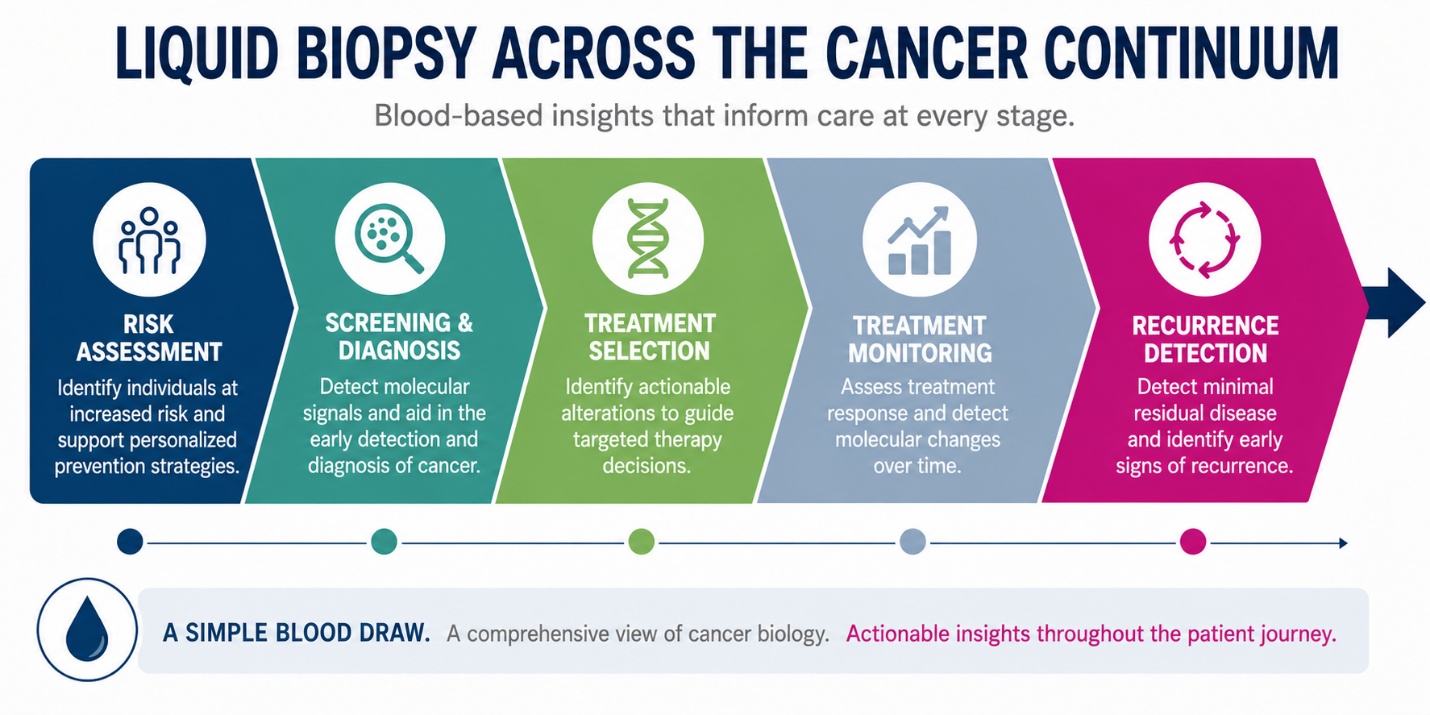
Blood-Based Testing Across the Cancer Care Continuum
Liquid biopsies are no longer limited to advanced cancer. Today, blood-based diagnostics are being evaluated and used across multiple stages of care including:
- Risk assessment and screening
- Diagnostic support
- Genomic profiling
- Targeted therapy selection
- Treatment response monitoring
- Molecular residual disease assessment
- Recurrence surveillance
Each application requires different biomarkers, different analytical approaches, and different clinical evidence.
The term liquid biopsy describes the clinical sampling method, not a single clinical use.
Why Biomarkers Differ for Various Clinical Questions
What Is a Screening Blood Test?
A screening blood test is designed to identify biological signals that may indicate the presence of cancer before a diagnosis has been established.
Unlike MRD assays, an early detection blood test is intended to identify biological signals before cancer has been diagnosed.
Early-stage cancers may shed very little tumor DNA into circulation. As a result, many screening assays evaluate broader biological signals, such as protein expression or multiomic patterns that may change before structural abnormalities become apparent on imaging. Depending on the assay, screening tests may analyze:
- Protein biomarkers
- Cell-free DNA (cfDNA)
- Circulating tumor DNA (ctDNA)
- Cell-free RNA (cfRNA)
- Circulating tumor RNA (ctRNA)
- MicroRNAs
- Epigenetic markers
- Multiomic biomarker signatures
Right now, given that the majority of screening assays are in their early days, these tests are intended to complement established screening strategies, not replace them.
For breast cancer, imaging remains the foundation of screening, with blood-based diagnostics emerging as an additional source of biological insight for selected patients.
What Is an MRD Test?
Molecular residual disease (MRD) testing serves a different purpose.
MRD assays are used after a patient has already been diagnosed and treated for cancer.
Their objective is to determine whether microscopic disease remains after surgery, chemotherapy, radiation, or other definitive treatment even when imaging shows no evidence of disease.
MRD testing may help oncologists:
- Assess recurrence risk
- Monitor treatment effectiveness
- Detect recurrence earlier than conventional imaging
- Inform decisions regarding adjuvant therapy
Most MRD assays analyze ctDNA and often use tumor-informed approaches, meaning the patient's original tumor tissue is sequenced to identify specific mutations that are then tracked in blood over time. The biology of recurrence monitoring differs greatly from the biology of early detection. Following treatment, the patient's tumor biology is already known. MRD assays can therefore focus on detecting minute quantities of tumor-specific DNA associated with residual disease. Because these tests look for known tumor-specific genetic alterations, they are fundamentally different from screening assays designed for individuals without a cancer diagnosis.
What Is the Certitude Breast Cancer Screening Blood Test?
Certitude™ is a breast cancer blood test, not an MRD assay. It is designed for women who have not been diagnosed with breast cancer but whose screening pathway may require additional clinical insight, including:
- Women with dense breasts (BI-RADS C or D)
- Patients with inconclusive or indeterminate breast imaging
- Women at elevated breast cancer risk as part of a comprehensive screening strategy
Rather than tracking known tumor mutations, Certitude evaluates protein biomarkers associated with breast cancer biology. The Certitude test may provide additional clinical insight during dense breast screening, particularly when imaging results are inconclusive.
According to Certitude clinical validation data1:
- >90% sensitivity
- Greater than 99% negative predictive value (NPV) in women with dense breasts
- Performed in a CLIA-certified, CAP-accredited laboratory
Certitude functions as a dense breast blood test designed for women with BI-RADS C and D breast density. The test is intended to complement mammography, MRI, ultrasound, and clinical risk assessment, not replace them.
For physicians, a negative result may provide an additional evidence-based data point when considering next steps in patients with complex screening scenarios.
Screening vs. MRD: A Clinical Comparison
| Feature | Screening Blood Test | MRD Test |
|---|---|---|
| Primary Purpose | Support early detection and screening | Detect microscopic disease after treatment |
| Patient Population | Individuals without a known cancer diagnosis | Patients previously treated for cancer |
| Clinical Question | Could cancer be present? | Has cancer returned or persisted? |
| Typical Biomarkers | Proteins, cfDNA, ctDNA, cfRNA, ctRNA, epigenetic or multiomic signatures | Primarily ctDNA based on known tumor mutations (tumor-informed) |
| Role in Care | Complements established screening pathways | Supports surveillance and treatment decisions |
| Replaces Imaging? | No | No |
Although both are blood-based tests, they are designed for entirely different stages of the patient journey.
Choosing the Right Test for the Right Clinical Question
As blood-based diagnostics continue to evolve, selecting the appropriate assay begins with understanding the clinical objective.
You may ask:
- Is the patient undergoing routine screening or post-treatment surveillance?
- Has cancer already been diagnosed?
- What biomarker is being measured?
- Has the assay been clinically validated for the intended use?
- Will the result influence patient management?
The answers determine which blood-based test is appropriate.
The Future of Precision Breast Care
Blood-based diagnostics are expanding the tools available to physicians across the cancer continuum.
Rather than replacing established standards of care, these technologies provide complementary biological insights that can support more personalized clinical decisions.
For women with dense breasts or more complex screening pathways, screening blood tests such as Certitude represent one example of how precision medicine is moving earlier in the patient journey helping physicians navigate uncertainty while remaining grounded in evidence-based care.
Learn More
Certitude is a breast cancer screening blood test intended to complement imaging rather than replace it. Interested in learning more? Connect with our team to review the clinical evidence, understand where the test fits in care pathways, and explore how it can be integrated into your practice.
Less uncertainty. More confidence.