With the Certitude Blood Test, you get Accuracy and Answers.
It’s finally here — a new way to detect breast cancer as early as Stage 0.


 ~50% of women have dense breastsCleveland Clinic
- Someone with dense breasts is ~2x more likely to develop breast cancerHolt DB, JAMA 2026, Lynge E, et al. Int J Cancer 2023
- 15% of women are high riskJiang, et al. (JCO Clin Cancer Inform 2019)


Who is this test for?
Certitude is for women 40+ who:
- Have dense breast tissue or inconclusive mammogram results
- Have a family history or elevated risk of breast cancer
- Need an additional layer of screening beyond mammography
- Want the peace of mind
The test has not been evaluated in individuals with a personal history of cancer, other active cancers, autoimmune disorders, or during pregnancy.
What is Certitude?
Peace of Mind From a Single Blood Draw
Certitude is a simple, accurate blood test designed to detect breast cancer in women with dense breast tissue.

Complements mammography for added confidence
Designed to screen for breast cancer as early as Stage 0 through protein biomarkers in your blood
Reduces anxiety for women who are high risk or those with dense breasts
How Certitude Works
Certitude analyzes specific protein patterns in your blood that are linked to breast cancer. Our advanced AI-driven technology detects these subtle changes—often before they can be seen on imaging.
Sample Processing
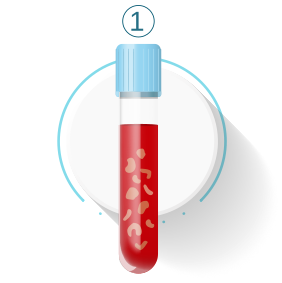
Blood Sample
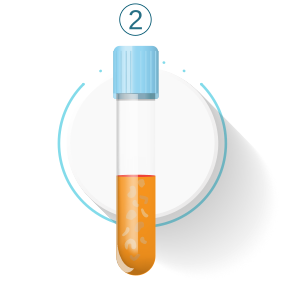
Protein Isolation
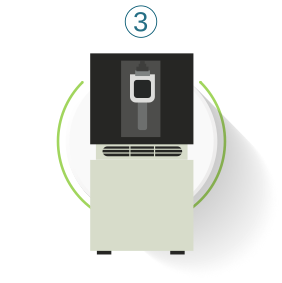
Protein Analysis
Data Analysis
Protein Identification

Machine Learning
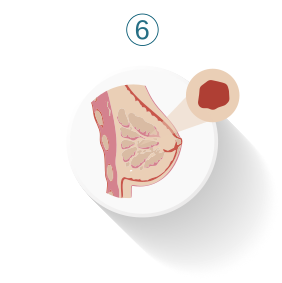
Cancer Proteins Detected
Backed by Clinical Data
Certitude’s performance remains strong across breast densities.
92%
Sensitivity
Drake (SABCS 2026)
90%
Sensitivity in Dense Breast
Horrmann (Endocrinology 2026)
91%
Sensitivity in High Risk Dense Breast
Advani (AACR 2026)
>93%
NPV
>99%
Negative Predictive Value (NPV)
92% Sensitivity: This means the test correctly finds cancer about 92 times out of 100 when cancer is truly present. In other words, it is very good at not missing cancers.
Negative predictive value (NPV) defines how likely it is that when someone receives a negative result, they do not have breast cancer. The Certitude Blood Test has a NPV of >99% meaning that of 100 women who receive a negative result, less than 1 of them will have undetected cancer.

Current Screening Performance
How does this compare with other screening options?
Compare published sensitivity and specificity across 3D mammography, ultrasound, CEM, and MRI for women with dense breasts. These data do not come from a head-to-head study but provide a comparative side-to-side view.
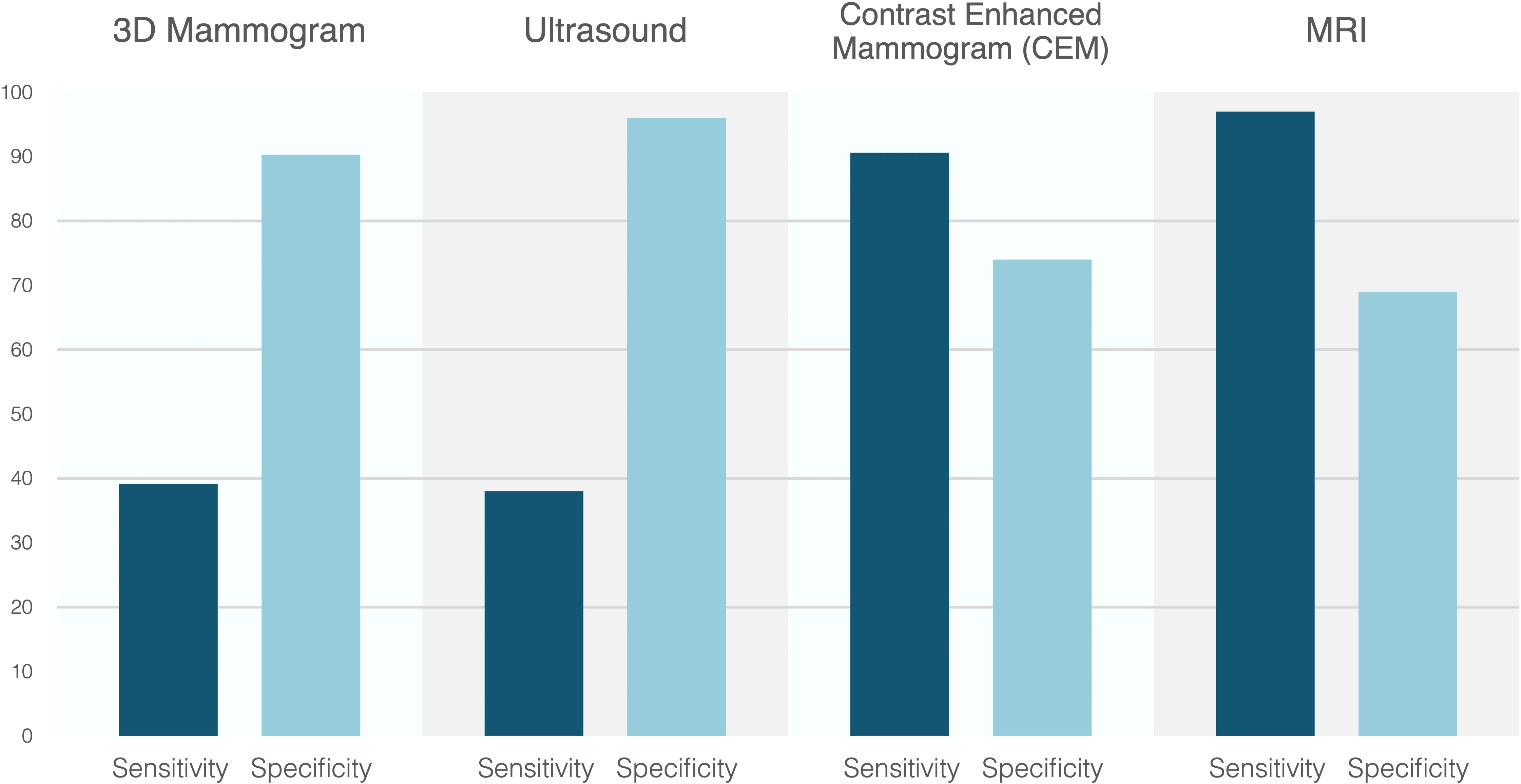
Comstock et al. (JAMA 2020)
Pötsch et al. (Radiology 2020)
Getting Certitude is Simple
From Requests to Results

Certitude is available by prescription. Your healthcare provider can order it. Coming soon — you can request it online through an independent telemedicine provider.
Download a Discussion Guide for Your Next Doctor’s Appointment


What Patients Say
“I did everything right — yearly mammograms, ultrasounds, follow-ups — and still my cancer was missed. Knowing a blood test could find what imaging overlooked gives me hope for the future. I want other women to have every possible chance to catch cancer early.”
“As someone with dense breasts, I have never felt like I had any clarity after my mammograms. Knowing that there is a test that could actually work for me gives me new found hope for me and all women who are at high risk for breast cancer.”
What Providers Say
“Too many women with dense breasts are left without clear answers after their annual screening. Certitude offers something we’ve needed — a simple, accessible test that can help detect cancer earlier and provide greater clarity. Certitude represents a meaningful and long-awaited advancement — one that can help physicians intervene sooner, reduce anxiety, and guide more confident clinical decision-making.”
Dr. Barbara LevyChief Medical Officer at Visana Health and Clinical Professor at George Washington University and UC San Diego Health“Mammography remains our most powerful population-level screening tool, but it is not perfect — particularly for the many women with dense breasts. A blood-based test that can identify molecular signals of cancer before they’re visible on imaging has the potential to fundamentally reshape the breast cancer screening paradigm.”
Dr. Ben H. ParkProminent breast cancer physician-scientist
Understanding Your Results


Straightforward Out-of-Pocket Pricing
Certitude is currently available to reserve at our introductory rate through our Early Access Program. Secure your spot today and lock in early access pricing before our anticipated price increase.
Certitude Test
For a limited time, eligible patients can secure access to the Certitude test at the introductory self-pay rate.
By joining the Early Access Program, you'll reserve your test and protect yourself from future price increases while securing priority access when testing becomes available.
Includes test kit, sample processing, digital results
No hidden fees
Payment handled through the patient portal
Reserve your Certitude test by December 31, 2026 to lock in the early access price of $525. Patients who participate in the Early Access Program will be eligible to complete testing in 2027 at their reserved rate, regardless of future price increases.*
*Early Access pricing is available only to patients who reserve their test on or before December 31, 2026. Testing must be completed in 2027. We anticipate the future list price for the Certitude test will be $750 or more after the Early Access period ends. Pricing may vary depending on the practice setting or healthcare provider who orders your test.

Certitude will be available in 2026 across the US.
Join our mailing list to be notified when it’s offered in your area.